
Felix the Cat story
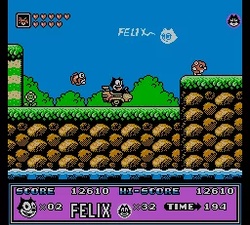
The story of Felix the Cat on NES is one of those rare moments when a silent-era icon suddenly springs back to life as a bright, no-fuss cartridge. Hudson Soft had a knack for turning familiar IP into warm, family-friendly adventures, and here they landed a hero with a backstory to rival any superstar. Felix the Cat, that cheeky rascal from the silent shorts, a black-and-white icon, shows up on 8-bit hardware not as a museum piece but as a bouncy, elastic character. The game lifts the essentials from the cartoons—charm, gags, and that magic bag of transformations—and builds a genuinely cozy platformer around it, free of clutter and stress.
Hudson Soft didn’t go for an academic homage. They doubled down on peppy chiptunes, big readable sprites, and a clean color palette—splashing the screen with the kind of lighthearted cartoon whimsy that made Felix beloved by your granddad’s generation. Here, Felix isn’t just a poster boy; he feels like a buddy you want to guide through every stage, just to keep hearing the music ring and those jumps snap so satisfyingly. That feeling doesn’t fade: the game is crafted with such care you buy in from the very first title screen.
From Screen to Cartridge
The leap from silent shorts to an NES cart sounds wild, yet it’s oddly logical. Felix existed as a symbol of an era—simple shapes, a clean silhouette, that unmistakable grin—perfectly suited to the language of pixels. The developers lovingly translated rubber-hose cartoon magic into gameplay rhythm: gadgets and goofs popping from nowhere, silly metamorphoses, and dangers that read playful instead of scary. The result is a version where Felix fits the 8-bit world like it was drawn for him from day one. That’s why Felix on NES never feels like a slap-on license: it’s a genuine meeting of early animation and the two-button age of A and B.
It’s also striking how well the game speaks to every age. For kids, it’s a gentle, readable platformer with clear logic and friendly pacing. For adults, it’s a slice of cultural memory—like a projector whirring right in the TV. There’s no film grain on screen, but the vibe is 100% there: slapstick, a grin, a punchline right around the corner. And no matter the language you say it in—Felix the Cat, Kot Felix—the name carries a neighborly warmth without pomp or pretense.
How "Felix on Dendy" Reached Us
Where we grew up, Felix the Cat came home the way many 8-bit joys did: through scuffed yellow carts, market stalls, and kiosk shelves. Labels often read just “FELIX” or “Kot Felix,” and sometimes the slightly goofy “Felix Cat.” On multi-carts—4 in 1, 8 in 1—it was printed tiny, in English, yet everyone knew it by feel: “Let’s fire up Felix on the Dendy.” That’s how it stuck: Felix the Cat, aka Kot Felix, aka Felix on Dendy—recognizable from the first screen. Bootleg cartridges made it even more accessible, so in every few neighborhood crews there was always someone who cleared Felix to the final boss in a single evening. And every time felt special.
The game’s trip was a long one—from Tokyo, past Hudson Soft displays, through collectors’ hands, and into our rooms, where the cable on a hand-me-down console rattled at every sneeze. But that’s exactly how “childhood classics” are born: not from splashy launches, but from a lived-in friendship with a cartridge. In that friendship, Felix the Cat (NES) proved a rock-solid companion.
Why We Loved It
Because it never rushes or nags. Because it flows like a tune you already know: steady tempo, handmade-feeling backdrops, a soft joke in every animation. A kind-hearted platformer is rare—and Felix is one of them. It doesn’t compete or wink with adult irony; it just invites you on an honest-to-goodness adventure. Whether you remember it as Felix the Cat in English, Kot Felix in Russian, or the cheerful “Felix Cat” from a sticker, one thing matters: on NES it delivered that calm confidence we now chase in retro collections.
There was also a Game Boy port—compact and travel-ready. It’s part of the same story: the same cozy spirit in your pocket, the same itch to see the level through and hum along to the theme. But the living-room Dendy version became the symbol: a big screen, old speakers, and that evening glow where Felix the Cat stops feeling like a licensed tie-in and becomes a cartoon you can step into.
Years later, “Felix on Dendy” needs no footnotes or excuses. It doesn’t try to be more than it is—and that’s why it still works. You can feel the studio’s touch for wholesome crowd-pleasers and a real love for the source—sincere, not textbook. That’s how the game traveled beyond its time and borders: from Japan and America to our street markets, school backpacks stuffed with carts, and family nights. And today, when someone says “Kot Felix,” everyone hears their own version—Felix the Cat, Felix Cat, that very Felix on NES—and smiles just like the black-and-white hero did a century ago.