
Felix the Cat Walkthrought
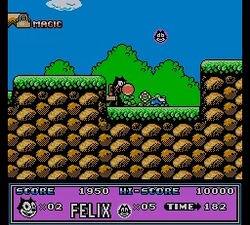
Let’s keep it simple: in Felix the Cat on NES, the single biggest key to a clean run is reaching bosses with a high magic level. Hearts from the money bags fill your meter and upgrade your transformation and weapon. Every hit is a downgrade. So the plan is straightforward: clear the path, scoop up hearts, and step into each arena fully charged.
Forest openers and the first boss
The opening screens are straight shots with no gotchas: low platforms, shrubs, basic fodder. Work in rhythms: step—shoot, step—shoot. See a bag on a ledge? Don’t rush it—clear the pests below, then take a diagonal jump so you don’t lose a heart to a stray bump. On long bridges, hold the center line: enemies love to “pop” from the edges, and one sloppy landing is an instant downgrade.
Right before the first boss there are usually a few hearts—don’t snatch them in a panic. Secure the approach, then chain the pick-ups so the upgrade locks in right at the door. On the arena, sit at mid-range, fire in bursts, and count his volleys—after three shots he pauses, and that’s your safe punish window. No need to jump: the pattern arcs predictably; half-step shifts are enough.
Water and air: pace and safe lanes
On water stages (inner tube, boat, then beefier rides), the pathing line is everything. Hug the top third of the screen: it’s easier to tag fish and harpoons before they touch your hitbox. Thread the gaps between shock pylons at an angle: quick nudge—shot—quick nudge. Don’t grab hearts tucked in risky “pockets” under overhangs—clear first, then loot. The water boss likes low torpedoes with a single high shot: stand just above center; the torpedoes slip under you, and you sidestep the high one with a small step back.
Air sections—balloon, then plane—are auto-scrollers with enemy “fans.” The name of the game is your safe lane. Sit a hair below center and fire to the scroll’s rhythm: most threats enter from top and bottom, and you want to clip their noses early. Don’t hold the button forever: short bursts save magic and register more reliably. Before the air boss, there’s usually a flat stretch with no pits—collect every heart without changing altitude to avoid stray bumps. On the arena he fires a triggered fan: after the first salvo, shift half a body; the second whiffs; the third gives you a clean pause for your burst.
Caves, ice, and tight corridors
In caves, don’t dive onto the lower lanes. Upper branches are safer: flyers are visible earlier and you’ve got room to fall back. Rocky lips often hide bags—see a stubby step with a “pocket”? Hop tight to the wall and ping the edge: you’ll “catch” the bag without dropping. In narrow tunnels, use the screen as your buffer: stop before the bend, let the scroll creep ahead, count spawns, then take the corner in an arc.
Ice means nasty inertia. Move in stutter steps: tap—shot—tap. Jumping’s fine, but always with margin—land dead center on platforms or you’ll slide off. Rolling enemies should be sniped early; don’t try a last-second hop—you’ll get carried away. Before the icy mini-bosses there are usually a couple of hearts on “steps”: take them bottom to top so you don’t slip back onto the ice without the upgrade.
Bonus rooms and how to run them
Secrets in Felix the Cat are simple and worth it: bonus-room entrances are marked with a bag icon. Step in and you’re in a small pocket full of hearts. The rule: don’t flail. Sweep clockwise, routing the loot so the last hearts are grabbed right by the exit—better odds your upgrade sticks when you pop back to the level. If there’s a 1-up with Felix’s face, snag it last—deaths in bonuses are rare, but losing a form to a rushed jump stings.
Final worlds: enemy density and upgrade economy
The closer to the finale, the more the game leans on numbers. Rhythm helps: two steps—two bursts—brief pause to let the screen “exhale.” On vertical towers, ride the right wall and clear diagonally down: spawns come from the left, you delete them on an angle before they crowd you. On moving platforms, don’t shoot mid-jump—the recoil and tiny delay will betray you; land, then burst. If you take a hit and drop a form, don’t grab hearts sitting under turrets: roll the screen back, clean house, return, then collect. That way the upgrade doesn’t evaporate.
Before the penultimate boss the game loves to hand you a “gift corridor.” Don’t vacuum it all at once. Park by the boss door, back up half a screen, then collect on the return so the upgrade procs as you enter. For the boss with layered projectiles, play the timing: after the rumbling volley there’s always a two-beat window—the first short, the second longer; hold fire on the second. If the pattern desyncs, don’t chase damage with jumps—one sidestep saves your form, and that matters more.
The finale and the Professor: hold the max
On the last stretch, don’t play hero. Any downgrade turns into a long, nervy cleanup. Stack your habits: safe lane, short bursts, clear before you loot. If there’s a “quiet” strip before a door—that’s your breather: grab hearts in the right order and enter with max magic. The Professor’s phases are readable: first pattern—crossing salvos; second—a pause where you can stand at an angle and unload; third—overheat and reset. Don’t face-hug—keep half a screen of space for micro-steps. Phase down? Keep the tempo, but don’t gamble: one guaranteed burst beats a damage trade.
If you want the nitty-gritty on upgrades and transformation hitboxes, hit /gameplay/—that’s the hub. The story and context behind Felix the Cat live at /history/. And for a Felix the Cat walkthrough, remember two things: hearts set the pace, and pace is arena control. Bank your magic for bosses, and Felix will pay you back with a smooth, stylish ride to the credits.